

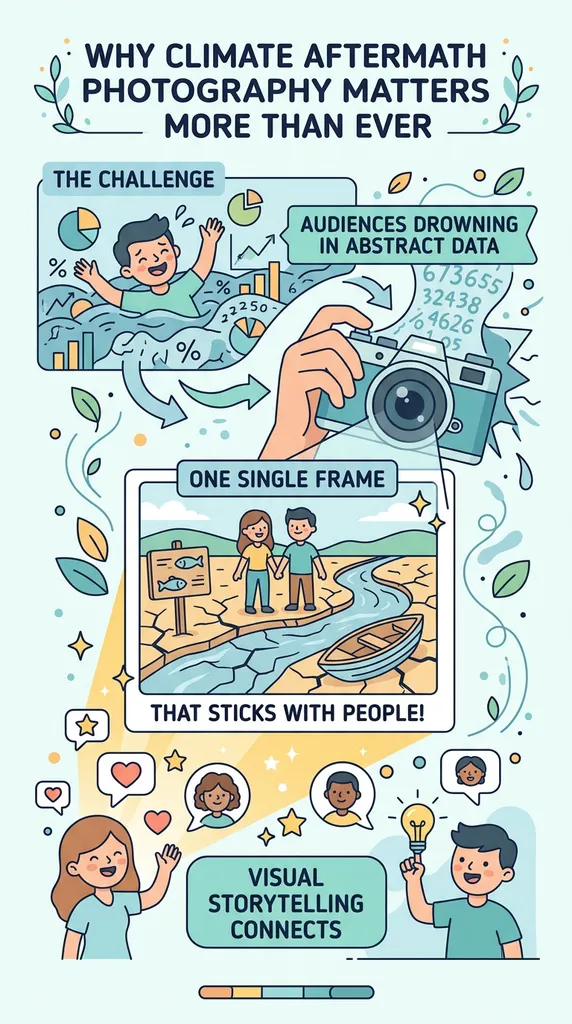
Visual storytelling
Why Climate Aftermath Photography Matters More Than Ever
Let's be honest — audiences are totally drowning in abstract data these days. Charts, graphs, and endless statistics all start to blur together after a while. But a single frame showing a cracked riverbed where a community once fished? That sticks with people. Visual storytelling has become the bridge between hard scientific reality and raw human emotion, and photographers are the ones holding the torch. That's exactly why photographing climate change aftermath has turned into one of the most vital skills a visual creator can develop in 2026.
In 2026, the demand for authentic environmental documentation has surged across newsrooms, NGOs, educational platforms, and documentary studios. Search interest around climate visuals and eco-journalism keeps climbing because people want proof, not promises. When it comes to photographing climate change aftermath, you're not just making pretty pictures — you're creating evidence. That's where you come in.
Understanding Climate Change Aftermath: Acute Disasters, Chronic Shifts, and Ecological Recovery
Before you grab your gear, let's clarify the terminology. Climate change aftermath isn't just about dramatic disasters. It covers a whole spectrum, and understanding that range is step one for photographing climate change aftermath effectively:
- Acute events — wildfire burn scars, flood recession zones, storm-damaged coastlines
- Chronic shifts — drought-stressed farmland, retreating glaciers, bleached coral systems
- Human dimensions — relocated communities, altered livelihoods, adaptation infrastructure
- Ecological recovery — regrowth patterns, species migration, restoration projects
Understanding this range helps you plan shoots that go way beyond the obvious. A thoughtful documentary approach captures not only destruction but also resilience, which makes for far more compelling narratives. And honestly, photographing climate change aftermath with that kind of nuance is what separates a forgettable snapshot from a frame that changes minds.
Camera Gear, Weather-Sealed Bodies, and Technical Setup for Hostile Environments
Let's talk equipment — practically, not obsessively. You don't need the most expensive body on the market, but you do need reliability. When photographing climate change aftermath, environments are often dusty, humid, freezing, or scorching. Here's what experienced field photographers generally prioritize:
Camera bodies: Weather-sealed mirrorless systems dominate the field in 2026. Dual card slots are non-negotiable — corruption happens, and you don't want to lose a once-in-a-lifetime frame. Many industry professionals favor full-frame sensors for dynamic range in harsh contrast situations, though high-end APS-C bodies remain popular for their reach advantage.
Lenses: A versatile zoom (roughly 24–70mm equivalent) covers most documentary work. Add a wide-angle for sweeping landscapes and a telephoto for compressing distant details and staying safe. A macro lens is surprisingly useful for capturing soil degradation, ash deposits, and vegetation stress up close.
Accessories that actually matter:
- Protective filters — cheap insurance against dust, sand, and salt spray
- Rain covers — even "dry" regions can turn on you fast
- Extra batteries — cold drains power unpredictably
- Sturdy tripod — essential for time-lapse and low-light documentation
- GPS-enabled logging — metadata integrity matters for verification
One more note: backup storage. Field conditions are unforgiving. Carry redundant drives and upload when connectivity allows. Reliable data management workflows separate professionals from hobbyists — especially when photographing climate change aftermath in remote locations where you won't get a second chance.
Composition Strategies: Scale, Contrast, and Comparative Documentation That Tell the Story
Technical sharpness is table stakes. The real challenge? Making viewers feel something. Here are composition approaches that consistently work when photographing climate change aftermath:
Scale and contrast: Pair human elements with environmental damage to communicate magnitude. A lone figure standing before a vast burn scar, a child's toy half-buried in dried mud — these juxtapositions create emotional weight that pure landscape shots often lack.
Before-and-after framing: If you can access historical reference points, recreate those angles. Comparative documentation is incredibly powerful and highly shareable. It also performs well in search — people actively look for visual comparisons of environmental change, which makes photographing climate change aftermath a smart long-term niche.
Detail over drama: Sometimes the most haunting image is the smallest one — cracked earth texture, a single dead sapling, waterlines etched on a wall. Macro-level environmental detail invites viewers to lean in and reflect.
The human element: Communities living through change are not props. When you include people, do so with consent, context, and dignity. Their stories anchor abstract issues in lived reality — a cornerstone of effective photojournalism ethics and responsible photographing climate change aftermath.
Ethical Considerations: Informed Consent, Avoiding Disaster Tourism, and Image Verification
This deserves its own section because it's where many well-intentioned photographers stumble. Photographing climate change aftermath involves real communities, real trauma, and real vulnerability. Some ground rules:
- Informed consent — explain how images will be used, plainly and honestly
- Avoid disaster tourism — if you can't contribute or document responsibly, reconsider the shoot
- Context is mandatory — captions should explain cause, location, and timeframe accurately
- No manipulation — heavy editing erodes trust; keep it authentic, especially for journalistic use
- Respect local customs — cultural sensitivity isn't optional
One seasoned field photographer once put it simply: "Ask yourself whether the subject would recognize themselves with dignity in your frame." That's a solid test — and it applies to every single assignment involving photographing climate change aftermath.
Light, Weather, Timing, and Long-Term Documentation Projects
Environmental aftermath scenes often look flat under midday sun. Plan around golden hour and blue hour for depth, but also embrace "bad" weather — overcast skies add mood, and post-storm light can be spectacular. Some of the most striking climate imagery emerges from moments most people avoid. That's the counterintuitive secret to photographing climate change aftermath that looks like nothing else out there.
Also think seasonally. Drought landscapes transform dramatically between spring and late summer. Wildfire scars shift from black to green within a single growing season. A long-term documentation project revisiting the same locations over months or years produces portfolios far more valuable than one-off shoots — and builds real credibility for anyone serious about photographing climate change aftermath.
Post-Processing, Metadata Integrity, and Building an Audience Through SEO Fundamentals
Editing should serve the story, not manufacture it. Basic adjustments — exposure, contrast, white balance — are standard. But heavy sky replacement or composite work can destroy credibility in an era where image verification tools are widely available and audiences are skeptical by default. Keep original files. Preserve metadata. Transparency builds trust, and trust builds a career in photographing climate change aftermath.
Great images deserve great reach. In 2026, visual creators distribute across editorial outlets, documentary platforms, educational partnerships, and social ecosystems. A few practical moves: build a portfolio site with strong SEO fundamentals — descriptive alt text, location-based titles, narrative captions. Pitch to environmental newsrooms and NGO publications with a clear story angle. Collaborate with researchers and educators who need visual assets. And share process and context, not just final frames — audiences love behind-the-scenes stories.
People searching for climate change photography and environmental storytelling are often educators, students, and editors. Serving those search intents with clear, well-captioned images drives organic discovery — and keeps the demand for photographing climate change aftermath growing year after year.
Finally, never forget safety and stamina. Post-disaster zones carry real hazards: unstable structures, contaminated water, toxic ash, extreme temperatures. Work in pairs when possible, carry communication devices, and respect access restrictions. No image is worth a hospital visit. The most impactful work isn't a single viral frame anyway — it's a body of work built over years, tracking changes, building relationships, and letting your archive mature. Photographing climate change aftermath rewards patience and purpose, and the world needs clear eyes and steady hands right now.